Yesterday I went to Brookhaven Labratory for a homeschool science class on soil with my friend.
Soil is made out of gravel, sand, silt, and clay.
Gravel is the biggest part of soil.
Clay is the smallest.
A tool called the sieve separates the gravel,sand, silt, and clay.
My first experiment was putting rocks into groups (not Igneous, Sedimentary, and Metamorphic.).
I came up with, dots, plain color, and stripes.
My second experiment was was with 2 rocks. My tools were a magnet and a piece of paper with some thing on it.
The clear rock on one side could make things bigger! The other rock was magnetic!
My third experiment was weighing, measuring the volume, and drawing samples of dirt.
After that, I went home.
Showing posts with label science. Show all posts
Tuesday, April 17, 2012
Wednesday, June 8, 2011
Honeybees
Yesterday I went to a honeybee class in Queens.
Honeybees go from flower to flower getting a little pollen and some nectar and every time they stop they drop off some pollen. This helps flowers and trees grow.
When they return to the hive they make some honey out of the nectar. I don't know how but check out this site to see how.
Pollen is also food for honeybees.
There are three types honeybees:
The queen, the workers, and the drones.
The queen only has one job: laying eggs.
The workers have lots of jobs.
The drones help the queen lay eggs.
And that last picture is me looking at a honeycomb.
Honeycomb is puked-up nectar and is always built in a hexagonal pattern.
Tuesday, June 7, 2011
Crabs
Yesterday I did a science class on horseshoe crabs:
Here's what I learned:
I saw 5 horseshoe crabs. All of the alive ones were mating. There was one dead one.
Horseshoe crabs species are shrinking because people are using them to test if drugs are safe.
Horseshoe crabs have blue blood because their blood is based on copper. Our blood is based on iron.
Here's what I learned:
I saw 5 horseshoe crabs. All of the alive ones were mating. There was one dead one.
Horseshoe crabs species are shrinking because people are using them to test if drugs are safe.
Horseshoe crabs have blue blood because their blood is based on copper. Our blood is based on iron.
Tuesday, April 5, 2011
Frogs and Turtles
Yesterday I went to a science class on frogs and turtles with homeschooled kids.
It was 40 miles away it was really fun and interesting.
Here's a fact about turtles - a turtle's shell is like the brain of a turtle, so if the shell is cracked the turtle will die.
Here's a fact about frogs - frogs will cover themselves with all sorts of stuff(slime, pollutants,etc) to protect themselves from predators.
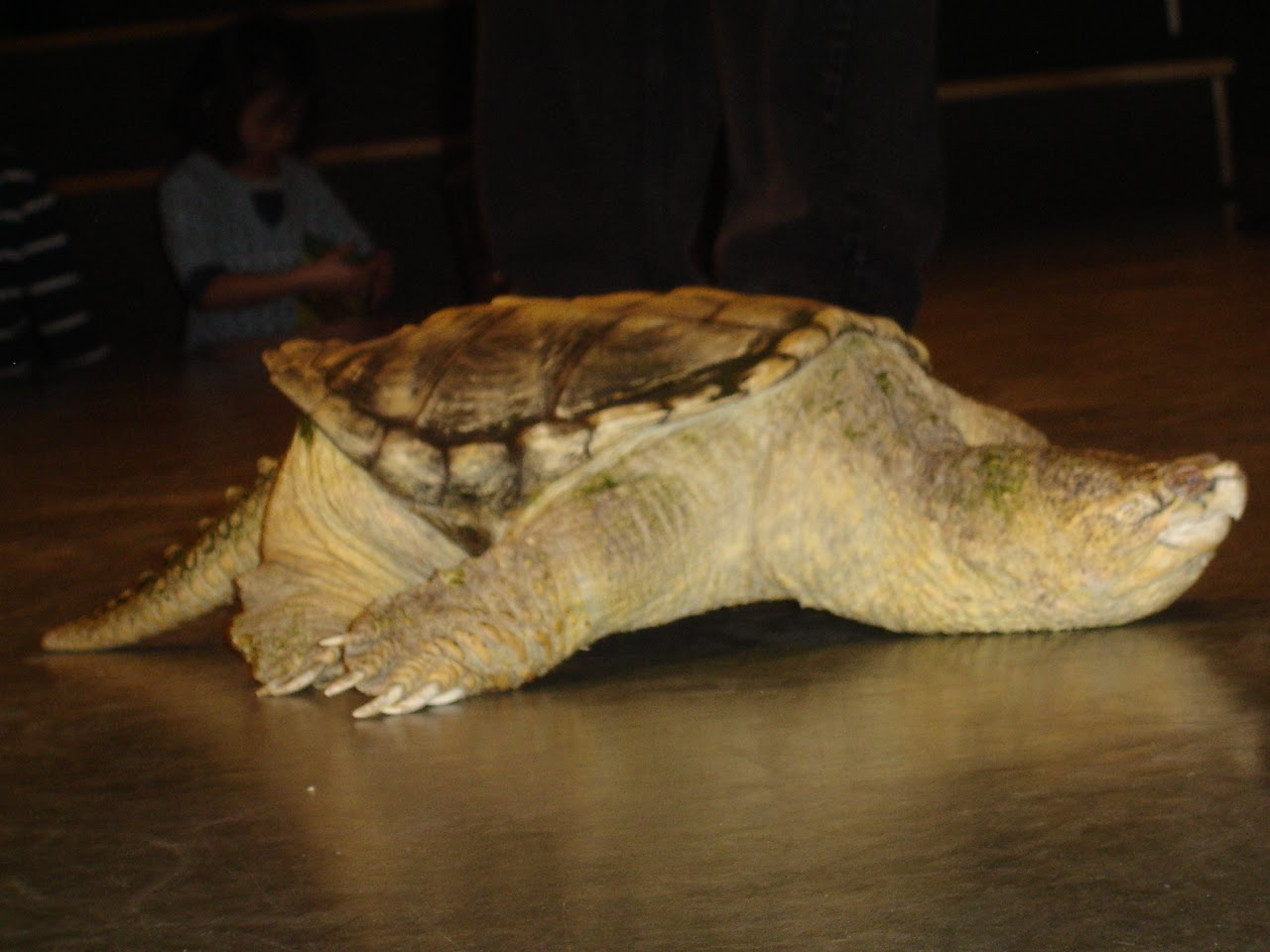
I saw a dead snapping turtle and a live turtle.
I heard 1 frog: a Spring Peeper.
Wednesday, March 30, 2011
Snap Circuts
As I said in the video, it is made of Snap Circuits.
I made it from the Snap Circuits Jr.
Some of the other fun projects you can make with the sets are:
Pressure Alarm
Laser Gun
Motion Detector
Wednesday, March 9, 2011
Stream Eroison
What they used is called a stream table
There was 2 types of streams: the young stream and an older stream. The difference is the older one has been carved out a little by water.
Stream erosion is when water overflows a stream, the faster parts carry the boulders and the cobbles and the slower water carries the pebbles, sand, silt, and clay.
And this how a stream in the real world takes shape.
Look how small clay is, I bet you didn't know that!
Thursday, October 21, 2010
Rubbery Egg
From this book:
In the Chemistry section, I did Experiment 196 - Rubbery Egg.
I put an egg in vinegar in a glass, and I waited several days.
Today we went to see the egg. We took it out and it felt rubbery.
Here's the explanation:
I put an egg in vinegar in a glass, and I waited several days.
Today we went to see the egg. We took it out and it felt rubbery.
Here's the explanation:
The vinegar reacts with the calcium in the eggshell, dissolving it. This makes the shell rubbery. This shows the importance of calcium to make the shell strong, just like the calcium in are bones.Keep drinking that milk!I don't know how but the vinegar must have done something to the calcium in the shell!
Ooze And Slime
2 days ago, in science class, I made Ooze and Slime.
To make Ooze, You need 1/2 tablespoon Cornstarch, Green food coloring, water.
To make Slime, click here.
Saturday, September 4, 2010
What Is Fire?
Fire is a chemical reaction with oxygen which releases a lot of energy. For more information click on my link.
We made a campfire last Saturday night.
My Dad and I got all the sticks.
We started a good fire with matches.
There are many ways to make a fire - click here.
Fires are very dangerous. You have to be careful and stay away from it because it could burn you.
Also there is danger from a fire spreading. So you have to keep anything that can burn far away. And you really have to watch where the sparks land.
To be safe, my dad brought the hose next to the fire.
Tuesday, August 24, 2010
Plant Lessons
Leaves are green from a chemical called "Chlorophyll".
Chlorophyll is a green pigment that helps the sun absorb energy.
Plants use that energy to make food. This process is called "Photosynthesis".
I also learned about two kinds of trees: coniferous and deciduous.
Coniferous trees are trees that have needles and cones , like a Christmas tree.
Deciduous trees are trees that have leaves, like a maple tree.
Q: Why do leaves change color from green to brown, red, and yellow?
A: In the fall, the chlorophyll disappears and the other pigments can be seen.
Thursday, August 12, 2010
Our Galaxy
I use this sentence↓to help me remember my planets:
Martha
Visits
Every
Monday
and (asteroid belt)
Just
Stays
Until
Noon
Period
The first letter of every word represents a planet.
For example: the "M" in Martha is represents Mercury, the first planet. And the "E" in every stands for Earth.
Monday, July 19, 2010
How Many Seconds Are In A Century?
Today I asked my dad how many seconds are in a century.
So he took out a piece of paper and we figured it out.
And here is our equation:
60sec/1minute · 60min/1hour · 24hours/1day · 365days/1year · 100years/1century = seconds in a century
This is called the factor-label method. All those fractions after the first one are actually equal to one.
When we multiply it out, most of the labels cancel out:
60sec/1
Now we have to do the arithmetic:
60 · 60 · 24 · 365 · 100 = seconds in a century
We tried doing it on a calculator, but the answer was too big!
So we factored it:
36 · 24 · 365 · 104
And multiplied the first part on the calculator:
315,360 · 104
Then we added four zeroes:
3,153,600,000
There are over 3 billion seconds of in a one hundred year period!
Friday, June 18, 2010
The Longest Day Ever!

In 2 more days it's the summer solstice.
That means it's the longest day of the year.
The sunrise is at 5:24am; and sunset is at 8:30pm.
So there are 15 hours and 6 minutes of daylight on Monday.
After that, the days get shorter everyday until the winter solstice.
On December 21st, the shortest day of the year, there are only 9 hours and 15 minutes of daylight.
After that, the days start getting longer again!
Tuesday, March 30, 2010
Pumpkin Seedlings
Monday, March 29, 2010
Blast Off!
Saturday, March 27, 2010
A Trip To Boston
Subscribe to:
Posts (Atom)